
Deutschlandstipendium Scholarship for International Students: 2026 Application Guide & Requirements
Deutschlandstipendium Scholarship 2026: The Ultimate Guide for International Students

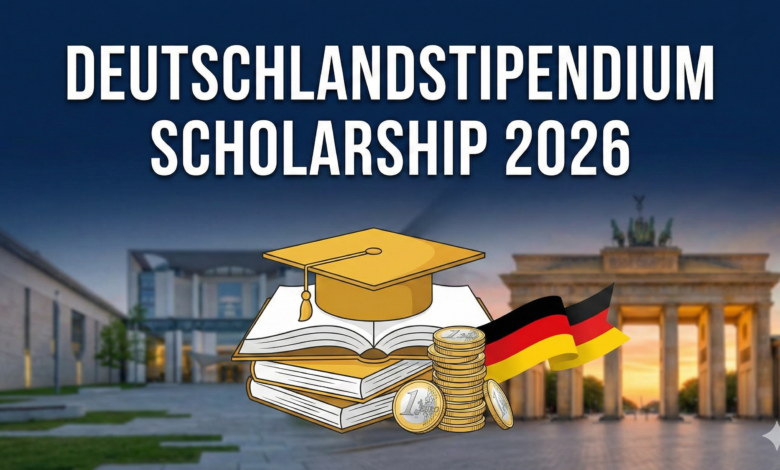
Deutschlandstipendium Scholarship for International Students: 2026 Application Guide & Requirements
The Ultimate Guide for International Students: Get Paid, Get Mentored, Get Hired.
Status: Applications for Winter Semester 2026 opening soon.
Value: €3,600 per year (non-repayable).
Target: High-achieving & committed international students.
Table of Contents
- 1. Why This Scholarship is Your Best Bet in 2026
- 2. The 300 Euro Model: Who Actually Pays You?
- 3. Eligibility: Are You Qualified? (The Truth)
- 4. The 2026 Application Calendar
- 5. The Document Masterclass
- 6. Writing a Winning Motivation Letter (Template Included)
- 7. The “Soft Factors” Strategy: How to Boost Your Score
- 8. University Spotlight: Specific Requirements
- 9. Bonus: The Scholarship Interview
- 10. Comparison: Deutschlandstipendium vs. DAAD
- 11. Frequently Asked Questions (FAQ)


In this comprehensive guide, we will move beyond the basics. We will dissect the 2026 selection criteria, reveal the “point systems” universities use to rank you, and provide you with the exact strategies international students are using to win.
2. The 300 Euro Model: Who Actually Pays You?
The Deutschlandstipendium is unique because it is a Public-Private Partnership (PPP). It operates on a matching funds principle:
- €150 comes from the German Federal Government (BMBF).
- €150 comes from private sponsors. These sponsors can be large corporations (like Siemens or BASF), Small and Medium Enterprises (SMEs), private foundations, or even university alumni.
Why does this matter to you?
Because you aren’t just applying to a university; you are auditioning for a potential employer. The private sponsor often gets to see your profile. If a company sponsors you, they often invite you to:
- Exclusive networking dinners.
- Plant tours and company workshops.
- Internship and thesis opportunities.
3. Eligibility: Are You Qualified? (The Truth)
Let’s debunk the biggest myth: “I need a 1.0 GPA to win.”
False.
While grades are the primary filter, the Deutschlandstipendium law explicitly requires universities to consider “holistic” criteria. Here is the 2026 eligibility breakdown:
The “Hard” Requirements
- Enrollment: You must be enrolled (or about to enroll) at a participating public or state-recognized university in Germany.
- Nationality: Open to ALL nationalities.
- Degree Level: Bachelor, Master, and State Examination students are eligible. (Ph.D. students are generally excluded, though some universities like University of Freiburg have exceptions—always check!).
The “Soft” Requirements (Your Secret Weapon)
This is where you can beat a candidate with better grades. Universities award points for:
- Social Commitment: Volunteering, student council work, or political engagement.
- Personal Circumstances: Overcoming obstacles. As an international student, you have a natural advantage here (migration background, learning a new language, financial independence).
4. The 2026 Application Calendar
The Deutschlandstipendium is decentralized. This means there is no single deadline. Each university sets its own.
| Intake | Application Window (Estimates based on 2025/26 data) | Funding Starts |
|---|---|---|
| Summer Semester 2026 | January 15 – February 28, 2026 (Common for Technical Universities like Stuttgart) |
April 1, 2026 |
| Winter Semester 2026/27 | June 1 – July 31, 2026 (Most common window, e.g., LMU, Heidelberg) |
October 1, 2026 |
| Late Window | September 1 – October 15, 2026 (Some Universities of Applied Sciences) |
Retroactive to Oct 1 |
Action Step: Go to your university’s website now and search “Deutschlandstipendium [University Name]”. Set a reminder on your phone for 2 weeks before the opening date.
5. The Document Masterclass
In 2026, most applications are digital (PDF uploads). Poorly formatted documents get rejected immediately. Here is your checklist:
1. The Application Form (Online)
This will ask for your data. Be precise. If it asks for “Volunteering hours per week,” be honest but don’t sell yourself short.
2. Tabular CV (Lebenslauf)
Germany prefers the Tabular CV.
Format: Reverse chronological order.
Photo: Professional headshot (highly recommended in Germany).
Focus: Highlight “Education” and “Social Engagement” as separate distinct sections.
3. Proof of Grades
- Freshmen: Your School Leaving Certificate (A-Levels, High School Diploma) translated and converted to the German grading scale.
- Current Students: Current Transcript of Records (Notenspiegel). Note: Some unis like University of Stuttgart require a specific “Ranking Certificate” that shows where you stand compared to your peers (e.g., “Top 10%”).
4. Enrollment Certificate
Your current Immatrikulationsbescheinigung.
6. Writing a Winning Motivation Letter (Template Included)
For international students, this is the most critical document. You must answer three questions:
- Why do you deserve merit-based funding?
- What hurdles have you overcome?
- How will you contribute to the network?
Structure of a 5-Star Motivation Letter
Header: Your Name, Address, “Application for Deutschlandstipendium”
Paragraph 1: The Hook.
“As a third-semester Data Science student at TU Munich, I am driven by the intersection of AI and sustainable energy. My current GPA of 1.4 reflects my academic dedication, but my journey to Germany represents my resilience.”
Paragraph 2: The Hurdles (The International Advantage).
“Moving to Germany from [Your Country] required me to master a new language and finance my studies independently. Currently, I work 15 hours a week as a warehouse assistant to support myself. While this has taught me discipline, it limits the time I can dedicate to my research projects…”
Paragraph 3: Social Commitment.
“Beyond academics, I believe in giving back. I volunteer at the ‘International Office’ as a buddy for new students, helping them navigate bureaucracy in Germany…”
Paragraph 4: The Impact of the Scholarship.
“The Deutschlandstipendium would allow me to reduce my work hours and focus on my upcoming thesis on [Topic]. Furthermore, I am eager to engage with the sponsor network, learn from industry mentors, and represent the university as an ambassador.”
SEO Note: Keywords like “academic excellence,” “social responsibility,” and “intercultural competence” act as trigger words for selection committees.
7. The “Soft Factors” Strategy: How to Boost Your Score
Many universities use a point system. Here is a hypothetical scorecard based on university guidelines (e.g., TU Dortmund, Bonn):
| Criteria | Possible Points | Strategy for International Students |
|---|---|---|
| GPA | 0 – 50 | Get the best grades you can, but don’t panic if you are at 2.0. |
| Volunteering | 0 – 20 | Join a “Verein” (club). Even 2 hours a week counts. Tutors and “Buddies” are highly rated. |
| Migration Background | 0 – 10 | Check this box! Being an international student often automatically grants these points at some universities. |
| Working Student | 0 – 10 | If you work to finance your studies, you get points for “Financial Hardship/Self-Financing.” |
| Family Circumstances | 0 – 10 | Care for relatives, single parenting, etc. |
If you have a 1.9 GPA but max out the “Soft Factors,” you can often outscore a German student with a 1.3 GPA who has zero extracurriculars.
8. University Spotlight: Specific Requirements
Different universities look for different things. Here is a snapshot for 2026:
Also check: ECOSOC Youth Forum 2026
Technical University of Munich (TUM)
Focus: Innovation & Entrepreneurship.
Tip: TUM has a massive network. If you have a startup idea or a tech project, mention it in your letter.
RWTH Aachen
Focus: Industry ties.
Tip: Almost all sponsors are engineering giants. Highlight practical skills and internships.
Freie Universität Berlin (FU Berlin) Deutschlandstipendium Scholarship 2026
Focus: Social Sciences & Political Engagement.
Tip: Heavily weighs social commitment. Mention political volunteering or NGO work.
University of Stuttgart
Focus: Strict formality.
Tip: As noted in recent guidelines, they sometimes exclude the motivation letter and look purely at grades and data entered in the form. Be meticulous with your data entry!
9. Bonus: The Scholarship Interview
Some universities (e.g., TH Köln) conduct interviews. If you get invited, you are in the top 10%. Here is how to ace it:
Common Question: “Tell us about yourself.”
Bad Answer: Reciting your CV.
Winning Answer: A 2-minute story connecting your background in [Home Country] to your passion for your subject and your future goals in Germany.
Common Question: “What do you know about the Deutschlandstipendium?”
Answer: Mention the Public-Private Partnership. “I know it is funded half by the government and half by sponsors like [Name a sponsor of that Uni]. I am particularly excited about the potential mentorship…”
Common Question: “How do you manage your time?”
Answer: Show resilience. “Balancing my part-time job, German classes, and my engineering coursework requires strict prioritization…”
10. Comparison: Deutschlandstipendium vs. DAAD
| Feature | Deutschlandstipendium | DAAD EPOS / Master Grants |
|---|---|---|
| Amount | €300 / month | €934 – €1,200 / month |
| Duration | 1 Year (Renewable) | 12 – 24 Months (Full Degree) |
| Competition | Medium (Competing with Uni peers) | Extreme (Competing globally) |
| Can you work? | Yes, unlimited (within visa rules) | Yes, but income *may* be deducted if high |
| Best For | Already enrolled students | Applicants not yet in Germany |
11. Frequently Asked Questions (FAQ)
A: Yes, in a good way! In many cities, the immigration office (Ausländerbehörde) accepts the scholarship letter as proof of income. This means you might need to block €300 less per month for the next year.
A: Yes. If you do an exchange semester while enrolled at your German uni, you can keep the Deutschlandstipendium AND get the Erasmus grant.
A: You don’t need to find the sponsor! The university finds the sponsor for you. You just apply to the university.
A: No. The Deutschlandstipendium is completely tax-free and does not count as taxable income.
A: Yes. First-semester students are highly encouraged to apply based on their school-leaving grades.
Your 2026 Action Plan
The Deutschlandstipendium is more than money; it is validation. It tells future employers that you were one of the top performers at your university. Do not self-reject.
1. Download your Transcript today.
2. Draft your CV in tabular format.
3. Write your “Resilience Story” for the motivation letter.
4. Apply.
