
HZB International Summer Program 2026 in Germany (Fully Funded)
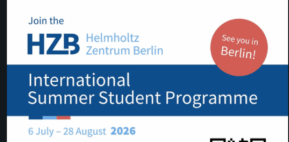
2026 HZB International Summer Student Programme in Germany (Fully Funded)

Meta Title: HZB International Summer Student Programme 2026: The Complete Guide
Meta Description: Discover the HZB International Summer Student Programme 2026 in Germany. A fully funded 8-week internship for physics, chemistry, and engineering students. Learn eligibility, benefits, and how to apply.
Meta Keywords: HZB International Summer Student Programme, HZB Summer Student Program 2026, HZB ISSP 2026, research internship Germany, paid summer internship Berlin, science scholarships Germany, Helmholtz-Zentrum Berlin student program, international student internships Europe, fully funded research opportunities 2026

HZB International Summer Student Programme 2026: Your Gateway to World-Class Research in Germany
Imagine spending your summer in the heart of Europe, working alongside some of the world’s most brilliant scientific minds, accessing state-of-the-art laboratories, and exploring the vibrant culture of Berlin. This is not just a dream; it is a tangible reality offered by the HZB International Summer Student Programme 2026. For science and engineering students globally, this program represents a “golden ticket” to academic excellence and professional growth.
The Helmholtz-Zentrum Berlin (HZB) is one of Germany’s premier research institutions, renowned for its cutting-edge work in energy materials and accelerator physics. Every year, HZB opens its doors to a select group of international undergraduate students, offering them a fully funded, eight-week research experience that often defines the trajectory of their careers.
In this comprehensive guide, we will dive deep into every aspect of the HZB International Summer Student Programme. From the intricate details of the application process to the specific research areas you can explore, and from the financial benefits to the day-to-day life in Berlin—this article covers it all. Whether you are planning to apply for the 2026 cohort or preparing early for future cycles, this post is your ultimate resource.
What is the HZB International Summer Student Programme (ISSP)?
The HZB International Summer Student Programme (ISSP) is an annual initiative organized by the Helmholtz-Zentrum Berlin for Materials and Energy. It is designed to bridge the gap between theoretical university studies and practical, hands-on research. The program typically runs for eight weeks during the summer months, usually from early July to late August.
For the year 2026, the program is expected to host approximately 20 to 25 exceptional students from all over the globe. These participants are not merely observers; they are integrated into active research teams. They work on their own projects under the supervision of experienced scientists, contributing to real-world scientific advancements.
Key Program Facts for 2026:
- Host Country: Germany
- City: Berlin (Wannsee and Adlershof campuses)
- Duration: 8 Weeks (Typically July 6 – August 28, 2026)
- Financial Coverage: Fully Funded (Stipend + Travel Allowance)
- Language: English
The program is highly competitive and prestigious. Being selected as an HZB Summer Student is a badge of honor that signals your potential as a future leader in science. It provides a unique platform to utilize large-scale facilities like the BESSY II synchrotron, a source of intense X-ray light used to study the structure and function of matter.
Why You Should Apply: Benefits and Opportunities
Why do thousands of students search for the “HZB International Summer Student Programme” every year? The answer lies in the unparalleled benefits it offers. Unlike unpaid internships that drain your savings, the HZB ISSP is a fully funded opportunity that values your contribution.
1. Generous Financial Support
HZB ensures that financial constraints do not hinder talent. Participants receive a generous subsistence allowance to cover living costs such as accommodation, meals, and local transport.
- Stipend: Approximately €1,900 gross for the entire duration (subject to tax adjustments). This amount is sufficient to live comfortably in Berlin for two months.
- Travel Grant: The program subsidizes travel expenses for getting to and from Berlin.
- Up to €200 for students travelling from within the EU.
- Up to €800 for students travelling from non-EU countries.
This financial independence allows you to focus entirely on your research and cultural experience without the stress of budgeting.
2. Access to World-Class Facilities
As a summer student, you gain access to laboratories that are often off-limits to undergraduates. You might find yourself working at the Berlin Electron Storage Ring Society for Synchrotron Radiation (BESSY II), conducting experiments that analyze energy materials at the atomic level. Or, you might work in the state-of-the-art labs for photovoltaics, developing the next generation of solar cells.
3. Professional Networking
You will work side-by-side with leading scientists, postdocs, and PhD students. This network is invaluable. A recommendation letter from an HZB scientist can open doors to top-tier Master’s and PhD programs worldwide. Additionally, you will meet fellow students from diverse backgrounds—your future colleagues and collaborators in the global scientific community.
4. Comprehensive Skill Development
Beyond the lab bench, HZB organizes a series of workshops and tours. These often include:
- Scientific Communication: Learn how to present your data effectively.
- Entrepreneurship: Understand how scientific ideas are translated into business ventures.
- Site Visits: Tours of other research institutes in Berlin and Potsdam.
At the end of the program, students typically present their findings in a poster session, a critical skill for any aspiring researcher.
Eligibility Criteria: Who Can Apply?
To maintain the high standard of the HZB International Summer Student Programme, strict eligibility criteria are in place. Before you start your application, ensure you meet the following requirements:
Academic Status
- You must be a student currently enrolled in a university.
- You must be studying a relevant field: Physics, Chemistry, Material Science, Structural Biology, Mathematics, Engineering, Life Sciences, or Environmental Sciences.
- Degree Level: The program is open to Bachelor’s and Master’s students. PhD candidates are not eligible.
- Experience: You must have completed at least two years of full-time university study in your major discipline by the start of the program. This ensures you have the theoretical foundation to handle the research tasks.
Enrollment Requirement
You must remain enrolled as a student at your home university for the entire duration of the internship (July and August 2026). If you graduate before or during the program, you may not be eligible.
Language Proficiency
The official working language of the program is English. You must be fluent enough to communicate scientific concepts, understand safety instructions, and socialize with your peers. While German language skills are an advantage for daily life in Berlin, they are not required for the program itself.
Reference Letter
You will need a letter of reference from a professor or supervisor who knows your academic work well. This letter plays a crucial role in the selection process.
Research Areas at HZB
The HZB International Summer Student Programme is not a “one size fits all” internship. You can choose to work in a specific area that aligns with your academic interests. HZB is a leader in energy research, and projects generally fall into these categories:
1. Photon Science
This field utilizes the intense light from BESSY II to investigate the properties of matter. Research might involve X-ray spectroscopy, microscopy, or scattering techniques to understand magnetic materials, biological systems, or catalytic processes.
2. Photovoltaics and Solar Energy
HZB is a global powerhouse in solar research. Summer students in this track might work on:
- Perovskite Solar Cells: improving stability and efficiency.
- Silicon Heterojunctions: optimizing established technologies.
- Thin-Film Technologies: exploring CIGS or CZTS materials.
You might contribute to creating more efficient, cheaper, and sustainable solar energy solutions.
3. Electrochemical Energy Storage
With the world moving towards electric vehicles and renewable grids, better batteries are essential. Projects here focus on analyzing battery materials, electrolytes, and interfaces to improve the lifespan and capacity of Lithium-ion and post-Lithium batteries.
4. Quantum and Functional Materials
This is a playground for physicists. Research focuses on topological insulators, quantum magnets, and other exotic states of matter that could form the basis of future information technologies (quantum computing).
5. Accelerator Physics
For those interested in the machines themselves, this area focuses on the physics of particle accelerators. You might work on beam dynamics, superconducting cavities, or the design of future light sources like BESSY III.
6. Catalysis and Solar Fuels
This area explores how to use sunlight to drive chemical reactions, such as splitting water to produce green hydrogen. It combines chemistry, physics, and materials science to solve energy storage challenges.
Step-by-Step Application Process for 2026
Applying for the HZB International Summer Student Programme requires attention to detail. The application process is entirely online. Here is a step-by-step guide to navigating it successfully.
Note on Timeline: Applications for the summer program typically open in October and close in mid-December of the previous year. For the Summer 2026 program, the deadline would generally be around December 14, 2025. If you are reading this after that date, check the official website immediately for any extended deadlines or late calls, or use this guide to prepare for the 2027 cycle.
Step 1: Gather Your Documents
Before you log in to the portal, have the following documents ready (usually in PDF format):
- Academic CV: A concise resume (max 2 pages) highlighting your education, research experience, skills (programming, lab techniques), and academic achievements.
- Transcripts: An up-to-date copy of your university grades. An English translation is usually required if the original is not in English or German.
- Confirmation of Enrolment: A document from your university proving you are currently a student and will be enrolled during the summer of 2026.
- Copy of Passport/ID: To verify your identity and nationality.
- Letter of Reference: This must be uploaded by your referee or attached to your application depending on the portal’s specific instructions for that year.
Step 2: The Online Application Form
Visit the official HZB website and navigate to the Summer Student Programme section. The application form will ask for:
- Personal Details: Name, contact info, citizenship.
- Educational Background: University, major, current semester.
- Research Preferences: You will be asked to rank your preferred research areas (e.g., 1. Photovoltaics, 2. Photon Science). Be honest here—this determines which group reviews your profile.
- Skills: Specific lab skills, software knowledge (Python, MATLAB, Origin), and language proficiency.
Step 3: The Motivation Section
While some years may not require a separate cover letter, there is often a section to describe your motivation. This is your chance to shine. Explain why you want to join HZB specifically. Mention specific research groups or technologies (like BESSY II) that fascinate you. Connect your past studies to the projects at HZB.
Step 4: Submission and Confirmation
Double-check all entries. Once submitted, you should receive an automated confirmation email. Ensure your referee also submits their letter by the deadline.
Life in Berlin: A Summer to Remember
Participating in the HZB International Summer Student Programme is not just about work; it is about living in one of Europe’s most exciting capitals. Berlin is a hub of history, culture, and nightlife.
The Campuses
- Wannsee: Located in the southwest, this campus is surrounded by lakes and forests. It’s peaceful, green, and home to the neutron research history and solar energy labs. It’s perfect for swimming after work.
- Adlershof: Located in the southeast, this is Germany’s largest science and technology park. It hosts BESSY II and is a bustling hub of innovation, with easy access to the city center via the S-Bahn.
Accommodation
While HZB provides the subsistence allowance, students are generally responsible for finding their own accommodation. Berlin is popular, so start looking early! HZB often provides a list of guest houses or student dorms. Shared flats (WG or “Wohngemeinschaft”) are a popular and affordable option, often costing between €400 and €700 per month.
Also Check:Merck Innovation Summer Camp 2026
Exploring the City
With your student status or the “Deutschland-Ticket” (a nationwide travel pass often available for ~€49/month), you can explore:
- History: The Brandenburg Gate, the Berlin Wall Memorial, and Checkpoint Charlie.
- Museums: The Museum Island (a UNESCO World Heritage site) is a must-visit.
- Nightlife: Berlin is famous for its techno clubs, vibrant bars, and open-air summer festivals.
- Green Spaces: Tempelhofer Feld (an old airport turned park) and the Tiergarten are great for summer picnics.
How to Write a Winning Application
Since the HZB Summer Student Program 2026 is highly competitive, here are expert tips to make your application stand out to the selection committee.
1. Tailor Your CV
Don’t use a generic CV. If you are applying for the Photovoltaics track, highlight your course modules on solid-state physics or semiconductors. If you have done any lab work, even as part of a class, describe what equipment you used.
2. Show, Don’t Just Tell
Instead of saying “I am hardworking,” give an example of a difficult project you completed or a problem you solved in the lab. Scientists love evidence.
3. Research the Mentors
Look up the research groups at HZB before applying. In your motivation, if you can mention, “I am particularly interested in Dr. X’s work on perovskite interfaces,” it shows you have done your homework and are genuinely interested.
4. The Reference Matter
Choose a referee who knows you personally. A generic letter from a famous professor is less valuable than a detailed, enthusiastic letter from a lecturer who supervised your lab project and can vouch for your practical skills.
Frequently Asked Questions (FAQ)
Conclusion
The HZB International Summer Student Programme 2026 is more than just an internship; it is a transformative experience that combines rigorous scientific training with the joy of cultural exploration. For students passionate about physics, chemistry, and materials science, it offers a rare glimpse into the life of a professional researcher at a world-class institute.
If you are ready to challenge yourself, build a global network, and spend a summer in one of the most dynamic cities in the world, the HZB ISSP is the opportunity you have been waiting for. Prepare your documents, polish your CV, and get ready to apply. Your summer of science in Berlin awaits!
For more details, always refer to the official HZB website.
