
Eiffel Excellence Scholarship Program Application Guide 2026: Campus France, Stipend & Master PhD Criteria

France has long stood at the vanguard of global science, philosophy, and international diplomacy. For ambitious international postgraduate scholars seeking to access France’s world-class Grandes Écoles and research universities, the Eiffel Excellence Scholarship Program Application Guide 2026 offers the definitive strategic blueprint for winning France’s premier academic award. Established by the French Ministry for Europe and Foreign Affairs (Ministère de l’Europe et des Affaires étrangères – MEAE) and operated internationally by Campus France, the Eiffel Excellence Scholarship program is specifically designed to train future foreign decision-makers in the private and public sectors across high-priority scientific and humanitarian disciplines.
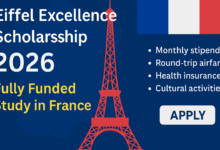
Unlike standard university bursaries, the Eiffel Scholarship represents an elite mark of distinction. The program funds two distinct degree tracks: Master’s degree level (awarding 12 to 36 months of continuous support) and Doctoral PhD level (funding up to 12 to 36 months under joint supervision or co-tutelle agreements). Master’s recipients receive a monthly living allowance of €1,181, while doctoral laureates receive a substantial monthly stipend of €1,800. Beyond direct cash stipends, the scholarship provides round-trip international flights, domestic train travel within France, local transportation subsidies, comprehensive Campus France complementary health insurance, cultural activities, and prioritized access to subsidized public university residences managed by CROUS. Candidates seeking comprehensive European scholarship insights should also examine our breakdowns of the Chevening Scholarship Essay Examples Leadership 2026 and the Rhodes Scholarship Oxford Selection Criteria Requirements to benchmark international leadership evaluations.
The Fundamental Rule: Institutional Nomination via French Universities
The single most critical operational rule that every prospective candidate must understand is that individual direct applications submitted by students directly to Campus France are categorically rejected without review. The Eiffel program operates strictly through an institutional nomination mechanism. Candidates must first apply to an accredited French higher education institution (a public university or Grande École). If the university’s academic admissions committee deems the applicant’s profile to be truly exceptional, the institution itself packages, endorses, and officially submits the candidate’s dossier to Campus France.


This institutional architecture creates a two-tiered timeline that catches thousands of candidates off guard each year:
| Evaluation Phase | Responsible Entity | Critical Deadlines & Milestone Actions |
|---|---|---|
| Phase 1: University Internal Pre-Selection | French Universities & Grandes Écoles | Late October – Late November 2025: Universities set internal deadlines to collect student dossiers, conduct academic interviews, and select their institutional nominees. |
| Phase 2: Campus France Dossier Submission | International Relations Offices of French Universities | Early January 2026: French institutions officially lodge their nominated candidate dossiers onto the private Campus France institutional portal. |
| Phase 3: National Expert Committee Review | Independent Academic Review Panels (MEAE) | February – March 2026: Disciplinary expert panels review dossiers across science, economics, management, law, and political science. |
| Phase 4: Official Laureate Announcement | Campus France & MEAE | Early April 2026: Results are published publicly on the Campus France portal, and laureates are officially notified to commence visa and housing arrangements. |
Strict Statutory Eligibility Rules: Nationality, Age, and Dual Citizenship
Before investing weeks in assembling an application, candidates must rigorously audit their compliance with Campus France’s non-negotiable statutory eligibility criteria:
- Nationality & Dual Citizenship Restrictions: The Eiffel Scholarship is strictly reserved for foreign non-French citizens. Candidates holding French dual nationality—even if residing abroad—are statutorily ineligible.
- Age Limits for Master’s Level: Candidates applying for the Master’s component must be at most 25 years old during the year of application (for the 2026 intake, candidates must be born after 31 March 2000).
- Age Limits for PhD Level: Candidates applying for the Doctoral component must be at most 30 years old during the year of application (born after 31 March 1995).
- Geographic Location for Master’s Applicants: For the Master’s level, applications from candidates who are already studying in France at the time of application are strictly ineligible. Master’s candidates must be residing abroad. (Doctoral candidates currently completing the first year of their PhD in France under co-tutelle or joint supervision remain eligible).
- Non-Cumulative Rule: Candidates who have previously received an Eiffel scholarship at the Master’s level cannot receive a second Eiffel award at the Master’s level (though they may be nominated later for the PhD level). Candidates who have already been rejected by Campus France for an Eiffel scholarship in a prior campaign cannot be re-nominated for the same study level.
Seven Designated Priority Study Fields
The French Ministry for Europe and Foreign Affairs allocates Eiffel awards exclusively across seven designated subject fields, split equally between the Hard Sciences and Human/Social Sciences:
| Disciplinary Category | Eligible Eiffel Priority Fields | Target Curriculum & Research Themes |
|---|---|---|
| Science & Technology (Hard Sciences) | 1. Biology and Health 2. Ecological Transition 3. Mathematics and Digital Sciences 4. Engineering Sciences |
Biotechnology, immunology, artificial intelligence, cybersecurity, renewable energy, materials science, aerospace engineering. |
| Humanities & Social Sciences | 5. History, French Language & Civilization 6. Law and Political Science 7. Economics and Management |
International public law, human rights governance, geopolitical strategy, development economics, quantitative finance, supply chains. |
Tuition Fees Nuance: Public Universities vs Private Grandes Écoles
A crucial financial nuance outlined in the Eiffel Excellence Scholarship Program Application Guide 2026 relates to tuition coverage. Unlike programs such as the British Chevening or Australian RTP that pay large university tuition bills directly, the Eiffel Scholarship does not directly reimburse tuition fees to the institution. Instead, the French Ministry provides the following statutory protections:
- Public Universities (Exemption from State Tuition): For scholars admitted to state-accredited public universities (e.g., Sorbonne Université, Université Paris-Saclay, Université Paris Cité, Aix-Marseille Université), Eiffel laureates are by law granted complete exemption from differential international tuition fees (droits d’inscription différenciés), ensuring the student pays zero tuition fees.
- Private Grandes Écoles & Business Schools: For scholars attending private engineering or business schools (e.g., HEC Paris, INSEAD, ESSEC, ESCP), where annual tuition can exceed €20,000 to €45,000, the institution itself must agree to absorb or subsidize tuition fees as part of their institutional commitment to nominating the candidate. Candidates must confirm this with the school’s international office before accepting nomination.
Step-by-Step Institutional Application Strategy
To win an Eiffel Scholarship, candidates must execute a proactive, multi-stage institutional engagement strategy:
Step 1: Identifying French Programs & Contacting International Offices (August – September 2025)
Search the Campus France catalog to identify eligible Master’s or PhD degree programs taught in French or 100% in English. Contact the department head and the university’s International Relations Office (Service des Relations Internationales) to express your interest in being considered for Eiffel nomination. Inquire about their specific departmental deadline for internal Eiffel candidate submissions.
Step 2: Preparing the Master Candidate Dossier (September – October 2025)
The university requires comprehensive academic and motivational documentation before agreeing to sponsor you. Your package must include:
- Curriculum Vitae: Formatted concisely in English or French (maximum 2 pages), detailing academic honors, publications, internships, and language proficiencies.
- Academic Transcripts & Class Rank Certificate: Official certified transcripts from all undergraduate studies. Crucially, French evaluation committees heavily prioritize class ranking certificates (attestation de classement) proving you graduated in the top 5% or 10% of your graduating class.
- Personal Professional Project (Projet Professionnel): A 2 to 3-page essay articulating your academic background, career trajectory, reasons for choosing France and this specific institution, and how your future career will foster bilateral commercial or scientific partnerships between France and your home nation.
- Language Certifications: For English-taught programs, IELTS (minimum 7.0) or TOEFL iBT (minimum 100); for French-taught programs, DELF/DALF C1 or TCF score reports.
Step 3: Doctoral Candidates: Supervisory Co-Tutelle Agreement (PhD Track)
For PhD applicants, the application requires a co-supervision or joint thesis (co-tutelle) agreement between the French research laboratory and the candidate’s home institution. The file must include an endorsement letter from the French thesis supervisor detailing the scientific novelty of the thesis project, laboratory equipment access, and the collaborative research schedule between both nations.
The French LMD System: Master 1 (M1) vs Master 2 (M2) Trajectories
Understanding France’s higher education architecture under the European Bologna Process (Licence-Master-Doctorat – LMD) is essential for selecting the correct Eiffel study duration:
- M1 + M2 Track (Up to 24 Months Funding): For candidates who hold a 3-year foreign bachelor’s degree (Licence equivalent), Eiffel funds up to 24 continuous months covering both the foundational Master 1 year and the specialized Master 2 year.
- Direct M2 Track (Up to 12 Months Funding): For applicants who already hold a 4-year bachelor’s degree, an Honours degree, or a first-year master’s qualification, universities frequently admit candidates directly into Master 2 (the final graduating year). In this scenario, Eiffel provides 12 months of funding including mandatory thesis writing and industrial internships.
- Engineering Degree Track (Diplôme d’Ingénieur – Up to 36 Months): For elite Grandes Écoles d’Ingénieurs, where the rigorous engineering cycle spans three years following competitive preparatory classes (CPGE), Eiffel provides up to 36 months of full financial support.
Doctoral Co-Tutelle Agreements and Joint Supervision Frameworks
The PhD component of the Eiffel Scholarship is structured around bilateral academic diplomacy. The French Ministry does not fund standalone doctoral studies where a candidate simply moves to France permanently. Instead, it promotes mobility and collaborative research through two mechanisms:
| PhD Supervision Model | Supervisory Structure | Degree Conferral & Funding Allocation |
|---|---|---|
| Joint Supervision (Co-Direction) | One French thesis advisor and one foreign thesis advisor; research conducted across both laboratories. | Candidate receives single doctoral degree from one university with co-direction notation; funded up to 12 to 18 months split into mobility stays. |
| Joint Thesis (Co-Tutelle) | Formal legal contract between French and foreign university; joint examination jury. | Candidate receives two distinct doctoral diplomas (one from each university); Eiffel funds up to 18 months across 3 mobility periods. |
Post-Study Mobility: The RECE Visa & Talent Passport (Passeport Talent)
Graduating as an Eiffel laureate from a French university positions scholars for exceptional European career progression under progressive French immigration law:
- Recherche d’Emploi ou Création d’Entreprise (RECE) Visa: International graduates of French master’s degrees are entitled to an automatic, non-renewable 12-month post-study residence permit (RECE). This permit grants unrestricted working rights across France to search for salaried employment or incorporate a registered business.
- Passeport Talent (Talent Passport – Qualified Employee): Once a graduate secures an employment contract paying at least 1.5 times the French statutory minimum wage (SMIC), they transition seamlessly onto a multi-year Talent Passport residence permit, which is exempt from standard French labor market testing (opposition de la situation de l’emploi).
- Passeport Talent (Researcher): Doctoral Eiffel laureates who secure post-doctoral fellowship contracts or university research appointments receive the 4-year multi-entry “Talent Passport – Researcher” permit, providing accelerated pathways to French permanent residency and citizenship.
Comparative Fellowship Matrix: Eiffel vs Chevening vs DAAD vs Erasmus Mundus
Understanding how the Eiffel Excellence Scholarship compares to other premier European government grants highlights its distinctive institutional prestige:
| Scholarship Award | Granting Authority | Monthly Living Stipend | Application & Nomination Mode |
|---|---|---|---|
| Eiffel Excellence | French Ministry of Foreign Affairs (Campus France) | €1,181 / mo (Master’s); €1,800 / mo (PhD) | Strict institutional pre-selection and nomination by French universities. |
| Chevening Scholarship | UK Foreign, Commonwealth & Development Office (FCDO) | £1,100 to £1,400 / mo + 100% full tuition | Direct candidate application on central portal + embassy interviews. |
| DAAD EPOS / Helmut Schmidt | German Academic Exchange Service (DAAD) | €934 / mo (Master’s); €1,300 / mo (PhD) | Direct application to university DAAD degree courses. |
| Erasmus Mundus (EMJM) | European Commission (European Union) | €1,400 / mo + full tuition across 3 EU nations | Direct application to joint multinational university consortium. |
Campus France Welfare and Practical Arrival Benefits
Laureates of the Eiffel Excellence Scholarship enjoy elite VIP logistical support through Campus France’s dedicated international reception services:
- Priority CROUS Student Housing: Campus France reserves furnished studio apartments and rooms in public student residences (CROUS) across Paris, Lyon, Toulouse, Grenoble, and other university hubs, sparing scholars from the grueling French private rental market.
- APL Housing Allowance (Aide Personnalisée au Logement): Scholars can apply for French government housing subsidies (CAF/APL), which reimburse between €100 and €250 per month of their rent, further augmenting their monthly disposable stipend.
- Campus France Health Insurance: Complementary private health coverage that supplements the French public universal healthcare system (Sécurité Sociale), providing 100% reimbursement for medical appointments, prescription medications, and dental/optical care.
- Cultural Activities & Gala Receptions: Scholars receive subsidized access to French cultural excursions, theater outings, ski trips in the French Alps, and formal diplomatic receptions hosted by the French Ministry of Foreign Affairs in Paris.
Frequently Asked Questions (FAQ)
Can I apply for the Eiffel Scholarship directly on the Campus France website?
No. Individual applications sent directly to Campus France are immediately discarded. Only accredited French higher education institutions are legally authorized to submit candidate files. You must first secure admission or pre-selection through an eligible French university or Grande École.
Can I be nominated by more than one French university?
No. Campus France enforces a strict single-nomination rule: if a candidate is nominated by two or more French institutions in the same year, all dossiers for that candidate are automatically disqualified and canceled. You must choose one institution to sponsor your Eiffel nomination.
Is knowledge of the French language required if my program is taught in English?
No. France offers over 1,700 accredited master’s and doctoral programs taught 100% in English, particularly in engineering, business, and natural sciences. If your degree program is English-taught, French language test scores are not required by Campus France (though basic conversational French is highly encouraged for everyday social life).
Can I work part-time in France while receiving an Eiffel scholarship?
Under the terms of the Eiffel Excellence Scholarship award, scholars are expected to devote their full intellectual energy and time to their academic degree programs and research. While French student visas legally permit part-time employment up to 60% of the annual working limit, working outside jobs is strongly discouraged and may require formal permission from Campus France if it interferes with academic obligations.
Strategic Success Checklist for 2026 Eiffel Excellence Candidates
Maximize your institutional nomination prospects by completing this chronological milestone checklist:
- Curriculum Matchmaking (July – August 2025): Search the Campus France database for master’s programs or PhD laboratories aligned with France’s seven priority disciplines.
- University Outreach (August – September 2025): Contact master’s degree program directors and university international relations offices; request their internal Eiffel nomination guidelines and submission deadlines.
- Class Rank & Transcript Certification (September 2025): Secure an official institutional letter from your undergraduate registrar verifying that you graduated in the top 5% or 10% of your cohort.
- Professional Project Formulation (September – October 2025): Draft a persuasive, 3-page personal professional project establishing clear bilateral diplomatic, economic, or scientific bridges between France and your home country.
- University Dossier Lodgement (October – November 2025): Submit your complete admission dossier to the French university well in advance of their internal pre-selection cutoff.
- Campus France Announcement (April 2026): Track the official laureate release on
campusfrance.organd begin your long-stay student visa (VLS-TS) application via the France-Visas portal.
Rigorous adherence to the Eiffel Excellence Scholarship Program Application Guide 2026 positions ambitious international scholars to secure France’s most celebrated fellowship, providing an unmatched gateway to academic prestige, cultural immersion, and executive leadership on the European and world stage.
